
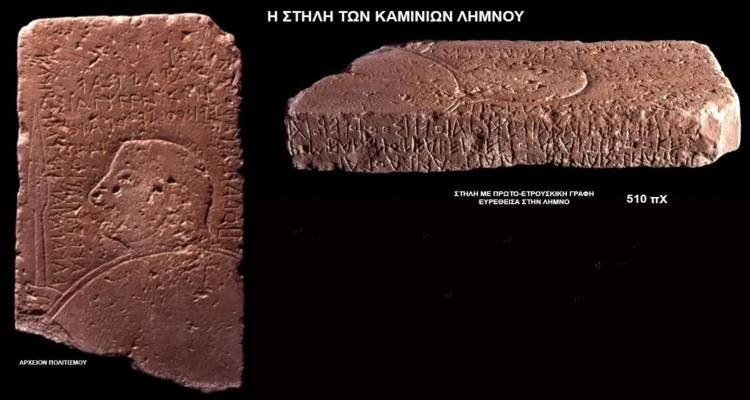
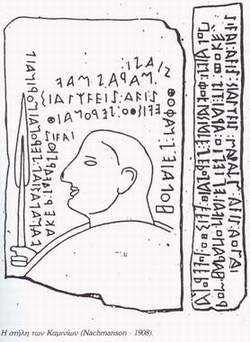
Η Στήλη των Καμινίων:
Πρόκειται για μια επιτάφια στήλη επί της οποίας υπάρχει το αρχαιότερο εως σήμερα γραπτό κείμενο. Ανακαλύφθηκε στα χαλάσματα εκκλησίας του Αγίου Αλεξάνδρου στο χωριό Καμίνια το 1885 από ένα ντόπιο αγρότη που επιχειρούσε να καθαρίσει το χωράφι του από τις πέτρες. Δημοσιεύθηκε το 1886 στο Δελτίο της Γαλλικής Αρχαιολογικής Σχολής Αθηνών. Το σπουδαίο εύρημα, εντοπίστηκε μετά από 20 χρόνια στη Αίγυπτο, από όπου ον παρέλαβε ο Βασίλειος Αποστολίδης και το δώρισε στο Εθνικό Αρχαιολογικό Μουσείο της Αθήνας.
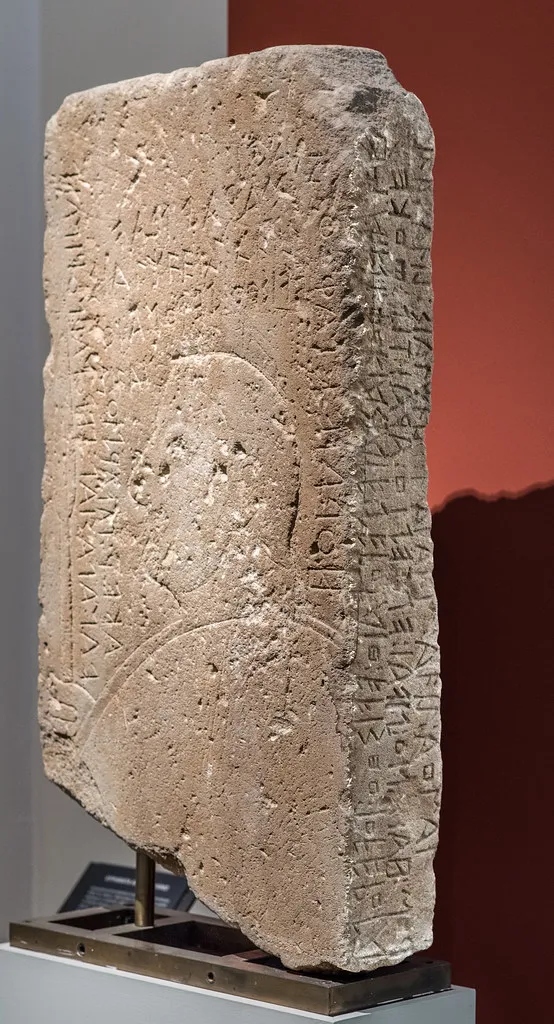
Παρακάτω η κα Μωυσίδου κάνει μια αξιόλογη προσπάθεια να αποκρυπτογραφήσει τα μυστικά της Στήλης της Λήμνου ώστε να δοθούν απαντήσεις σχετικά με την χρονολόγησή της αλλά και τη γλώσσα του κειμένου της.
Το άρθρο είναι γραμμένο στην αγγλική γλώσσα, ώστε να απευθυνθεί σε κάθε λάτρη της αρχαιολογίας, είτε Ελληνα είτε ξένο.
THE AMBIVALENT SCRIPT OF THE STELE OF LEMNOS
Only a few phoenician inscriptions have been found. Their words are very repetitive and have an official, or religious meaning. So the stele of Lemnos should also be a religious text, but of what kind? Though linguists would be pertinent for its deciphering, it is worth trying! (two different translations included).
ΤΗΕ STELE'S HISTORY IN SHORT... IN "LIMNOSREPORT"
"Τhe stele was found in Sokastro, Lemnos, during the ottoman empire. It had been buried by its owner in a field to protect it from the turks. The owner's son dug the whole field to find it. He later loaded it on a ship and sent it to Alexandria in Egypt, in order to cover its discovery, but the ship's captain claimed that the ship had suffered damages and that the stele was missing. After revealing the captain's fraud, the greek consul gave the stele back to its owner and he finally gifted it to the national arcaeological museum".
(https://www.limnosreport.gr/eidiseis/83154/stili-tis-limnoy-ena-apo-ta-megala-aini/).
ATTEMPTS TO DECIPHER THE SCRIPT'S MEANING HAVE FAILED..
-On “ΜΕΤROPOLITAN MUSEUM ATHENS” facebook we read the following: "Various fascinating theories have been put forward about its age and the language it hides. Recently ceramic sea shells with similar writing have been discovered and thus the stele on the one hand was accurately dated to the 6th century. e.g. (before 510, when Miltiades occupied the island and "Lemnian" was replaced by Attic Greek), on the other hand, the relationship of this barbaric Lemnian language -according to Homer (Iliad i 293-294)- as a language related to the etruskan has been sufficiently documented".
(https://www.facebook.com/MetropolitanMuseumAthens/photos/a.375336935891260/500135000078119/?type=3).
- In "FINESTRE SUL'ARTE" magazin we read regarding the stele: «The reading is controversial: according to one possible interpretation, the inscription commemorates the warrior Aker son of Tavarsa (Aker Tavarsio), representing descent from members of an illustrious family of Lemno. A second interpretation identifies him instead as a Holaie (in Greek Hylaios) perhaps from Phocaea in Asia Minor. The stele was a burial marker».(https://www.finestresullarte.info/mostre/fondazione-luigi-rovati-stele-di-kaminia).
- In "LABRUJURAVERDE" we read that the language is similar to etruskan: «By comparison with Etruscan, a language with which it seems to have many similarities, the phrase aviš sialχviš (sixty
years old), reminiscent of the Etruscan avils maχs śealχisc is interpreted».(https://www.labrujulaverde.com/en/2020/09/the-lemnos-stele-a-funerary-inscription-from-the-6th-century-b-c-that-links-the-pelasgians-to-the-etruscan).
So what could the script's language be?
AN HYPOTHESIS
The mason's language is a turkish dialect written in greek alphabet. The dialect contains arabic elements, like for example the article “AL” in the middle of word “ΣΙ-AL-HVE-IZ” and other words too (nayith, nayim etc); many of the script's words and verbs not only have the same meaning in turkish as today, but also the same spelling.
Yet one should make some remarks.
For example: the letter "Z" in the word "MAΡAZ" on the stele's front part, becomes an arrow pointing downwards in the same word on the stele's side part (????↓).
This could be an indication that the mason intentionally interchanged greek alphabet letters in a few words of his text to show us which letter he meant, as in antiquity the orthography varied from city to city.
Yet the mason did not follow the standard orthography for "Z" in the word "MAΡAZ", as the letter "Z" in greek alphabet was written as an "I" with two distinct lines: one on top and the other at the base of it.
The same goes for the arrow pointing downwards (↓): this sign was used to indicate the greek "X" (in english "KHI") and not the so to speak english “H”. Had the mason's intention be to convey the letter "H" (as in the word "house"), he would have used the letter "?", as he did in the first word of the stele's front part, in the word "HULAYIE". So in case the mason meant to distinguish the word MARAZ on the stele's front part from the word MARAKH(I) on the side part, one should understand that the mason was referring to the “AKHI brotherhood” (“AKHI” means “brother”, while “MAR” means “snake”, but also “generous” and “former”, “bygone”), as we'll see next.
“Akhi” (as the original spelling was, deriving from arabic) was a mystical religious and commercial fraternity, made up from builders, craftsmen, merchants and traders of all kinds, which flourished in islam, while their beliefs originated from Iran. Akhi was also a 13th-14th century municipality in the area of modern-day Ankara. Possibly the name “Akhiyava”, attributed to the greek Achaii, originally meant the members of this fraternity, as “brothers”. Sufis, mevlevi monks and islam's mystics were all brothers, “akhi". Today AKHI members are masons; this is what one may read on their site (https://akhi.org/): "Membership is by invitation, and members must be subscribing of a regular Craft Lodge and subscribing a Mark Master Masons Lodge".
BUT IF THE STELE'S TEXT IS REFERRING TO THE AKHI BROTHERHOOD, ΤΗΙS WOULD BE INDICATION No 1 THAT IT WOULD BE AN EARLY CHRISTIANITY OR EVEN MEDIEVAL TEXT AND NOT AN ANCIENT ONE, AS ARCHAEOLOGISTS PUBLICLY STATED.
And the word “SHIALHVEIZ” would possibly be “SHIA AL خوى (ḵwē) IZ”, that is “we are followers of the ???”.
“Shia”= follower; “iz”=we are; the word "???" in the middle is uncertain; it could be:
-"SHIA (A)L HAVII IZ": WE ARE FOLLOWERS ΟF FEAR (A CERTAIN DOGMA MAYBE?). But in such case followers of fear of what? As no point of reference to a particular cult or religion was made here, I had to dismiss this as a plausible meaning.
or
-"SHIA LAHAVI IZ": WE ARE FOLLOWERS OF THE FEAR OF GOD (DOGMA), if the word "LAHAVI" was the original form to express “fear of God”, as today the word "lahavie", as an exclamation, means "my God!"; "for God's shake!".
-The rest of the words could alternatively have another meaning too; meaning, which becomes obviously ambivalent when trying to translate the text. Namely the text could be an open complaint from the part of the Akhi sekt followers, who felt resentment due to peoples' attitude towards them; the feeling of being treated as “outcast”, due to their religious beliefs/tactics.
In many instances, as I tried to translate the whole text, I had the inkling that something was missing; that a slight difference in rendering the meaning would lead to another reasonably founded result, a totally meaningful one; that the text could be a “contemporary” -so to speak- religious text written by a member of a religious fraternity, to express his bitterness to present and future members of the same sect.
- The word “AVIZ” could be “AV IZ”: “WE ARE PREY”;
- The word “MARAZ MAV” on the front part of the stele for example, could be “MAR AZ(A)M(I) AV”, meaning “SNAKE, THE GREATEST PREY”;
- The word “NAΦOTH” could be “(I)NAKUT(H)”: “CULT”, had “Φ” been used to denote “qoppa”, as the mason did not use a standard greek city's alphabet, but interchanged some letters. I had to dismiss such a possibility though, because the mason used the same letter "Φ" in the word "ΦΟΚΕ", to undoubtedly denote the word "ufuqi".
But then I thought: maybe he used the same letter with different meaning each time, taking advantage of the greek alphabet's spelling's variation in different cities?
- The word “HULAIEZ”: the letter "L" is not clear on the original stele's front part, though it is clearly pictured as such in the stele's fotos available online. A closer look at the original gives the impression that it could be a "P" (written in the text as "?") and not an "L" (written in the stele's fotos as "?"). So this word could either be “HU (A)L' AĞI (I)Z”: “WE ARE THE WEB OF HU”, or, if the word were “HUPAIEZ” (HU PAYE IZ), it would mean “WE ARE HU's PAGANS”.
IF SO, THIS WOULD BE INDICATION No 2 THAT THE STELE'S TEXT WOULD BE AN EARLY CHRISTIANITY ONE, AS THE WORD “PAGAN”, RARELY USED IN CLASSICAL ANTIQUITY, BECAME COMMON FOR ANCIENT CULTS' ADHERENTS ONLY AFTER COMMON ERA.
Note:
-the letter “E” in ancient greek was pronounced as “i”; as in the preposition “in”, but as a prolonged one, as two “i”; so the mason used this letter for the same purpose in some of his words, whereas in others he used it to denote the arabic, aramaic or ottoman "e"; a common practice in greek antiquity too, as the different spelling of "E" on Nestor's cup shows (https://el.wikipedia.org/wiki/%CE%91%CF%81%CF%87%CE%B1%CF%8A%CE%BA%CE%AC_%CE%B5%CE%BB%CE%BB%CE%B7%CE%BD%CE%B9%CE%BA%CE%AC_%CE%B1%CE%BB%CF%86%CE%AC%CE%B2%CE%B7%CF%84%CE%B1#/media/%CE%91%CF%81%CF%87%CE%B5%CE%AF%CE%BF:Nestor_Cup_Pithekoussai.svg).
-the letter "A" could have been used by phoenicians (and the mason) to denote the letter "A" (alef) with a hamzah, the glottal stop, or simly the letter "A".
The rest of the words didn't match in this context though. But the first phrase “HULAIEZ (or HUPAIEZ) NAFOTH ZIAZI” had already caught my attention.. And it came as no surprise to learn that the term “SUFI” means “the one who is pure in heart", or "one of the pure”, which refers to “the phrygian cathars'” sect, considerd “a thorn in the eye” of the church fathers; an heresis, dating back to the manichean gnostics of the 2nd century AD. Manis οr Manichaeus (Mânâ in iranian and aramaic meant “luminescence”), the sect's founder, was of iranian origin; he was well informed about hinduism and zoroastrianism and spread his doctrines all over Parthia, the modern Iraq and Iran and Phrygia, the modern north-central Turkey, where the hattians and the hittites had their main lands).
REGARDING THE SPELLING OF SOME WORDS
- THE MAIN DIFFICULTY which I encountered while trying to decipher the script was that apart from god “AKER", the mason did not name the other gods he described; he used a vague
language instead, mentionning only the gods' properties and their actions' results. So I had to delve into ancient egyptian beliefs in order to understand what the mason was talking about.
Another difficulty was the assembling of the words written on the stele one next to the other, into separate phrases which would make sense.
The last difficulty was the most common one for ancient scripts: one cannot be absolutely sure of the words' pronounciation οr spelling.
- Although the mason wrote the word "??I???" (side part, line A:3b) with a final "E", that is with a long "i", he obviously meant a short "i", as the word's pronounciation today is, or maybe the pronounciation has changed. This could serve as a clue though, that he may have not used the letters as usually and by the "E" further written in the word "SIALKHVEIZ", he could mean a short "i", instead of a long one.
The same "mistake" is repeated in the word "FUKE" ("FUK-II"; side part, line B:6). The phrase there, is "ARAITIZ FUKE" ("resting IN the horizon"). Still the word "FUKE" cannot possibly be declined as "FUK-I" in the genitive case, as is the case with the phrase "FUKIASIALE" = "OF the eastern horizon" and as "FUK-II" (FUKE) in the dative case, as happened in the phrase "resting IN the horizon"; at least there is no precedent of words' endings changing by one "i" while being declined in the genitive and dative case in turkish. But maybe this dialect had different grammatical rules.
- On the side part we see that arabic letters are introduced, another clue that the stele should be an early christianity and not an ancient text.
THIS COULD BE THE STRONGEST INDICATION -IF NOT THΕ ABSOLUTE PROOF- THAT THE STELE'S TEXT IS AN EARLY CHRISTIANITY AND NOT AN ANCIENT ONE, SINCE THE EARLIEST ARABIC ALPHABET DATES FROM 512 CE ON A TRILINGUAL INSCRIPTION IN SYRIAC, GREEK AND ARABIC FOUND IN ZEBED/SYRIA; UNLESS SOME NEW DISCOVERY OVERTURNS
WHAT WAS KNOWN UNTIL TODAY (https://www.britannica.com/topic/Arabic-alphabet and https://www.islamicawareness.org/history/islam/inscriptions/zebed).
If this arabic/ottoman word was written in arabic as it appears in the stele's foto, it would either be ايلوا (AILUA), or اسيلوا (AS(H)ILUA). Both words do not mean anything though.
The original script of the stele seems to convey a different meaning, as there seems to be an "X" under this arabic word (an X under a letter was mainly used to replace its dots);
moreover this word's initial letter, as it appears in the original script, seems shorter than the initial letter appearing in the foto. This variation seemingly not so important, makes a huge difference though, as the initial letter should in the later case be an "L", not an "A". But even in this case there is no meaningful word (in the script's context) beginning with an "L".
As the mason's language was apparently rich in definite nouns, one should assume that the right word should be الشاوي (AL SHAAWII) preceeded by the article "AL" and that the letter "A", initially written as an upright line (ا) before this word, must have been corroded. In any case a "shepherd" should have been a high-ranking person in the cult. This assumption is corroborated by the script's following word: "AIVZI" (distinct).
- The lack of knowledge of the mason's language grammatic rules accounts for a few errors that may occur in the words' declension and the verbs' tenses.
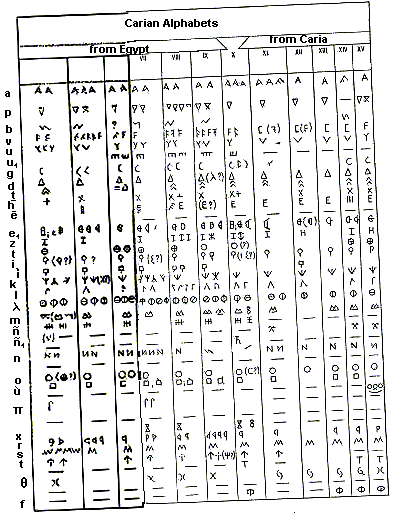
- The square, obviously used by the mason to render the vowel "U", was used in the carian alphabet for this same end (https://tied.verbix.com/project/script/asiam41.gif).
- The word "NAFOTH" (NAFOTH or NAFUTH) is of aramaic origin. Arabs do not have the vowel "O" in their language, but phoenicians' language contained a lot of hebraic elements. In hebrew "o" (oh) is a common vowel, like in the word "NAFOTH" below. So the mason used this letter either to convey the arabic "ou", or aramaic words.
- The word "Z???" appears three times as a synthetic in the words "Z?????I??", "Z?????I?" and "Z???Z?I??"; so it should be conveying the same meaning (ZER= gold and ZERU = golden).
- On the front side of the stele the letter "Σ" appears in the beginning (like in the word ΣΙ????EΙΖ) and in the middle of words (like in the word "???ΣI??"), whereas on the side part of the stele the letter "?" appears in the beginning (?Ι????ΙΖ) and in the middle of words ("??I???"). Maybe the mason's intention was to distinguish "sh" from "s", with the two greek letters ("Σ" and "?") being respectively used?
Of course the meaning of a word would be different if the word was spelled with "sh" intead of "s". The assumption that the mason meant to distinguish between two different letters should be overturned though, as on the stele's side part the letter "?" takes the place of "Σ" in the word "ΣΙ?????ΙΖ" seen on the front part, written with an initial "Σ". So "ΣΙ" and "?Ι" should have the same meaning in both cases and should be spelled either as "SH" or as "S", depending on this word's surrounding letters' context.
(The letters Σ and ? were both introduced into greek alphabet by phoenicians, to convey alternately the phoenician shin "W"(sh) -no equivalent in greek- and san "Σ" (s) and appeared on inscriptions mostly in Attica and the Cyclades https://el.wikipedia.org/.../%CE%91%CF%81%CF%87%CE%B1%CF).
- The meaning could be different in the word "ΣΙ????EIΖ" (SHIALKHVEIZ) on the stele's front part from the word "ΣΙ????IΖ" (SHIALKHVIZ) on the stele's side part, unless the mason tried to reduce his words on the side part, in order to save space. Namely the "E" in the first word could indicate a long "i", thus implying the word "HAVII" (fear), whereas in the word "ΣΙ????IΖ" the lack of the vowel "E" and the presence of a simple "I" after "?" could imply the word "HAVI" (containing). But since the word "HAVII" (fear) in "SHIAL-KHVE-IZ" led to no logical results in the translation, I had to assume that the mason purposely omitted the letter "E", writing "SHIALKHVIZ" on the side part. Maybe he meant to correct a mistake made on the front side.
So the mason leaves the discovery of his spelling to us. This is his own "spell" cast on the stele!
The only possible way to read his text is to compare the words to arabic, hebrew and turkish old ones or still in use. This was the so-called "protosemitic" language after all!
But as I am neither an archaeologist, nor a linguist to come to a safe conclusion and I cannot recourse to other sources to make comparisons, I just hope that one day enough available sources shall be found in order for some experts (specialising in comparative linguistics of anatolian languages) to finally dispel all doubts.
Now I shall first try to translate the text in the context of a religious sect cultist's dedication (or prostest) and then proceed to its other possible religious meaning, in the frame of a dedication to egyptian gods. Both translations give a coherent meaning, but my opinion is that the text is purposely written in the form of a dedication to gods, in order to "covertly" reveal its true identity as a cultist's dedication to a like-minded brother.
THE "CULTIST'S" TRANSLATION
1. "??????Z" = HU (A)L AĞI ΙΖ = "WE ARE THE WEB OF HU" or HU PAYE (I)Z = "WE ARE HU's PAGANS".
"?????" "ZI?ZI" = ΝΑFUTH (or NAFOTH) ZIAZI = "WE ILLUMINATE (WE EMIT LIGHT)";
or, if "Φ" was meant as qoppa: "(I)NAKUT(H) ZIAZI" = "A LUMINOUS CULT".
3. "????Z" "???" "ΣΙ?????IZ" "??IZ" = MAR AZMA V(A)SI AL KH(A)VI IZ-AFI (I)Z = "A ONCE VAST INTERBREEDING, CONTAINING REGISTERED MEMBERS".
Note
-the word KHAVI is written today as HAVI (havi), without "K"; written with a short "I", it means "containing". This is the most probable translation.
-in the word ΣΙ?????IZ, the ending "(I)Z" joins the next word, the word AVIZ, thus becoming "IZAVIZ";
-in the word IZAVIZ, the ending (I)Z is contracted with the next word, the word EVISHTU, thus becoming IZEVISHTU.
4. "(I)Z" "??IΣ?o" "Z?????I??" "ZI??I" "????" "?????ZI??" = IZEVISTHU (it is from this word that the contemporary word IZAFI should derive) ZERU NAITH ZIVAI AKER TAVARZITH =
"SPECIFICALLY GOLDEN ATTENDANTS OF THE SPLENDID MODEST AKER".
5. "??????ΣI??" "Z?????I???I??I?" "الشاوي" "?Ι?ΖΙ" "?O?I??I???" "Z???Z?I?" "??IΣ?O" "Ιο??????" = V' AM AL ASYAL ZERU NAIM ORI NAIL, SHAYAOUI AIVZI (U)FUKI ASIALI ZERU ZAIH EVISHTHU YUVARUNA = "AND USUALLY AN ASIAN PARTICIPATES IN THE GOLDEN BLISS OF LIGHT, (AS) A DISTINCT "SHEPHERD" OF THE EASTERN HORIZON, (WHICH IS) THE GOLDEN BORDER OF THE LIVING GLOBE".
"?o?" "????Io" "ZI??I" "?ΓΙ?ΖΙo" "???ΙΤΙΖ" "?O??"; "ZI??I" "??IZ"; =
RUHM HARAYU (this should be the original form of the word "HIRA") ZIVAI EĞEZIU ARAITIZ UFUQI; ZIVAI AVIZ; = "ΤΗΙΝ SPIRΙΤ OF THE SPLENDID TILTING ONE, RESTING IN THE HORIZON; SPLENDID STEWARD;"
7. "ΣΙ????ΙΖ" "????KHI" "?" "??IZ" "?O??I" = (I)SHI AL KHAVİ 'Z, MAR AKH(I)M AVIZ AUMAI = "WE ARE AN ALL CONTAINING FORCE, MY FORMER BROTHER, STEWARD AUMAI (or OMAI)".
CONCLUSION
- The most coherent translation is the cultist's one, but the mason separated the words in a such a way, that at first sight a dedication to egyptian gods emerged.
- Apparently there have been secessionists (contradicting dogmas) in the Akhi cult and the mason was trying to unitize them, in order to allow their cult gain its former power and political status.
So the text is neither "a protest letter", nor an expression of bitterness; rather a recommendation to all cult's members, never to forget their obligations towards their distinct brothers in Anadolu and Levante, who insist to participate in all kinds of illuminated brotherhood's joys, as they do in the other world, after all.
- The text is a also a fairwell one in memory of a deceased old fellow, as the expression "MAR AKHIM" implies; a deceased fellow, whose name was (A)UMAI, or OMAI. If the name was written in arabic as it was spelled by the mason in greek alphabet, its orthography would be: اوماي. The names (A)UMAI, OMAI and AUMEI still exist, either as names or surnames.
SOME FACTS TO HELP US UNDERSTAND THE SCRIPT'S MEANING AS A DEDICATION TO EGYPTIAN GODS AND AS A FAIRWELL TO A DECEASED BROTHER (AKHI)
- THE CARVED FIGURE on the stele, apart from portraying a dead fellow, could also represent the God of the sky and the sun HOR (HORUS), as it is him who was always depicted as a man carrying a spear. Hor was called "Hor Noubti" (Hor the winner), as he won his uncle Seth and castrated him, becoming a symbol of victory. Hor had two eyes; one was the sun. The other, the moon. Like the horizon does. HORUS'S soul was ORION; so these two merge in peoples' beliefs. HORUS/ORION was also worshipped as RA and as AKER, his other name being "RA-HOR-AKER”; He was also "HOR HUDITI" (or "HOR BEHEDETI") and "HORAKHTI" ("HUDUT" is a turkish word. It means "border"; so "Hor Huditi" was the horizon expanding from east to the west; expanding to the borders).
- ATUM rendered as Atem or Tem, was the primordial god in egyptian mythology from whom all else arose. Atum was closely associated with the evening sun. AS A SETTING SUN, "ATUM" COULD ASLO BE A PERSONIFICATION OF THE DIYING (SETTING) ATOM-INDIVIDUAL ("The Dying Sun": An Iconographical Analysis of the Solar Barque at Sunset in the Cosmological Books of the New Kingdom, https://digitalcommons.memphis.edu/cgi/viewcontent.cgiarticle=3271&context=etd, p. 20: "In depicting (ATUM'S) the solar deity’s journey, the cosmological books reference themes of rebirth, death, and regeneration through the lifecycle of the sun").
-AKER was the egyptian god of the horizon and the underworld. He defended the sun god from the serpent Apep (Apophis). So maybe his existence implied the fact that only E/M energy shall never perish. In his role as a protective deity, twin lion statues representing Aker were placed at the doors of palaces and tombs to protect against evil spirits, a practice adopted by both the greeks and romans. Aker replaces the god Kherty, becoming now the "ferryman of Ra in his nocturnal barque". Aker also protects the sun god during his nocturnal travelling through the underworld caverns and guards the "gate to the yonder site".
- HU (ḥw) in ancient Egypt was the deification of the first word, the word of creation, exclaimed by Atum. Hu was depicted in human shape, as a falcon, or as a man with a ram's head. "HU" is a word pronounced by the "mevlevi dervishler" while they swirl.
- VARUNA was the hindu deity for the sky; a proto-Indo-European sky god, who was adapted to different cultures (OYΡΑΝΟΣ in greek), as was Mithra the iranian god. The word "YUVARU" is turkish and means "globe" ("ΣΦΑΙΡΑ", "ΥΦΗΛΙΟΣ", in greek).
- ISIS was Hor's mother, therefore Hor was called "Hor-sa-Iset". Plutarch in his work "On Isis and Osiris" tells us that the goddess Isis symbolized the star Sirius in the constellation of Canis: "I am the one who rises in the star of Canis, following Orion in the constellation of Osiris". Sirius (in Canis major) lies under Orion following him; Orion was the personification of Isis's husband, Osiris. Isis was often represented as a woman wearing the white crown of Upper Egypt topped by a star. She had many appellatives, as her hymn in the Oxyrhynchus papyri implies, one of them being "Aphrodite".
Τhe planet Aphrodite, visible in the sky before the sunrise and after the sunset, accompanies the sun's path as its "huri". So in both cases, either as Sirius or as Aphrodite, Isis, Horus's mother, accompanies her winner husband Osiris-Orion and her son Horus-the triumpant sun/horizon god. Isis was worshipped from England to Afghanistan. Inscriptions dedicated to her have been found in ancient Golgi near Ammochostos, Cyprus, the main domain of alasyi (http://www.polignosi.com/cgibin/hweb?-A=12848&-=limmata).
- HATHOR, identified as Aphrodite (so as Isis too), was worshipped in the form of a cow, as “queen of the west, dance and music”; she was goddess of the skies, residing there with her companion Ra. Hathor accompanied Ra on his journeys across the sky and protected him by taking the form of a four-headed cobra. Hathor’s name in egyptian meant “house of Horus”, which may refer to her dwelling in the sky, or, to the belief that Horus was born to her every morning. So Hathor was considered Horus' mother.
- ISLAM'S religious tradition has it, that there are either one hundred, or seven levels in paradise (JANNAH); one of them is called JANNAT-AN-NAIM (“paradise of delight”). This level is where devotees and martyrs reside. Such beliefs apparently derive from pre-islamic traditions, as the words “havien” (deriving from “havii”) and "naim" (still in use) imply (https://zamzam.com/blog/seven-levels-of-heaven/).
- The first name of CYPRUS was "Alasya", inhabited by "alasyi" (http://www.famagusta.org.cy/En/page/405). The turkish name for Asia is “Asya” and should derive from the arabic “al Asya”. Ιn Isaiah chapter 23,2 (the septaguint translation) the cypriots are called “Kiti-im” (“im” is an arabic ending), transacting with phoenician merchants, but also descendants of phoenicians (ΣΠΕΡΜΑ ΜΕΤΑΒΟΛΩΝ). The language of maronites in Cyprus could serve as an example of the language spoken by the biblical kitiim; cypriot maronitic is a mixture of aramaic, arabic and greek (https://twitter.com/SonOfJenin).
TRANSLATION OF THE TEXT AS A DEDICATION TO EGYPIAN GODS
FRONT PART
- ETERNAL HU, SHINING HIGH ABOVE!
- WIPE WORRIES AWAY (ALL) CONTAINING FORCE, STEWARD ALIVE, GOLDEN ATTENDANT OF THE SPLENDID MODEST ΑΚΕR!
- AND MOTHER, THE ALASYAN, SHARES THE GOLDEN BLISS OF LIGHT.
DISAMBIGUATION:
THE MASON CONSIDERS "HU", "RA", "HOR" AND "AKER" AS THE SAME GOD.
FIRST LINE
THE MASON PRAISES "HU" AS "RA", THE SUN.
SECOND LINE
THE MASON PRAISES "HU" AS HOR "HOUDITI" (or "BEHEDETI") AND AS STEWARD OF RA "HARAKHTI" (THE SUN TRAVELLING FROM EAST TO THE WEST).
HE ALSO PRAISES "HU" AS AKER-RA's STEWARD.
THIRD LINE
THE MASON PRAISES ISIS:
-AS ΤΗΕ PLΑΝΕΤ APHRODITE, HER SUN'S HOR-RA (THE TRIUMPHANT SUN) COMPANION,
-AS SIRIUS, ACCOMPANYING HER HUSBAND ORION-OSIRIS, THE WINNER,
-AS HATHOR, GODESS OF MUSIC AND DANCE, BANQUETS AND FEASTS, HORUS's MOTHER AND RA's CONSORT, WHO SHARES HER HUSBAND'S AND SON'S BLISSFUL LIGHT.
SIDE PART
- DISTIΝCT SHEPHERD OF THE EASTERN HORIZON WHO IS THE GOLDEN BORDER, LIVING OVER THE GLOBE!
- THIN SPIRIT OF THE SPLENDID TILTING ONE, RESTING ALONG THE HORIZON;
- SPLENDID STEWARD, (ALL) CONTAINING FORCE, MY FORMER BROTHER, STEWARD (A)UMAI (or OMAI)"!
DISAMBIGUATION:
FIRST LINE
THE MASON PRAISES HIS DECEASED FRIEND/BROTHER AS FOLLOWING THE PATH OF THE SETTING SUN, THE PATH OF “RA HARAKHTI”; THIS PATH LEADS TO THE WESTERN BORDER OF THE HORIZON.
SECOND LINE
THE MASON PRAISES HIS DECEASED FRIEND/BROTHER AS “THIN SPIRIT” IN THE HORIZON.
THIRD LINE
THE MASON CONTINUING HIS REFERENCE TO HIS FRIEND, USES THE SAME APPELATIVES HE USED ON THE FRONT SIDE OF THE STELE FOR “HOR HUDITI" (“ZIWAI” AND “AVIZ”) AND REVEALS HIS FRIEND'S NAME: (A)UMAI or OMAI. HIS FRIEND HAS NOW BECOME AN ALL CONTAINING FORCE.
CONCLUSION
THE MASON KNEW THAT:
-E/M FORCE MANIFESTS ITSELF IN THE HORIZON AS SUN (HEAT) AND AS FLOWING ENERGY (LIGHTNING, THUNDER); SO IT IS THE HORIZON WHO IS "HIDING" (COVERING UP) THE
E/M FORCE!
-GODS' NAMES CONTAINED ALLUSIONS TO PHYSICAL FORCES; THEREFORE THE GODS WERE WORSHIPPED APART FROM EACH OTHER BUT ALSO UNITED AS ONE GOD, WHOSE NAME,
COMPOSED OF ALL OTHER GODS' NAMES, INDICATED A UNIFIED FORCE.
WORD ANALYSIS AS A DEDICATION TO EGYPTIAN GODS
(IN ORDER TO FACILITATE THE READER, I HAVE WRITTEN ΤΗΕ WORDS FROM LEFT TO RIGHT).
FRONT PART OF THE STELE
1a. "??????Z" (HU LAYEZ), if this is the right word on the stele, as the letters are not so clear:
- “HU” was an egyptian god.
-“Layezal” in turkish means “eternal”; so "LAYEZ" could be an abbreviation, or this word's initial form.
1b. "?????" (NAFUTH or NAFOTH):
- in israeli language this word is found in the old testament (Naphoth-dor, "the heights of Dor," maybe the slopes of Carmel inland from TanTurah).
- in arabic language "NFTH" means "to emit" among other meanings; so this word could either mean "the heights", or "to emit", depending on the similarity of the language spoken by the stele's carver with that of the bible.
1c. "ZI?ZI" (ZIAZI):
- in arabic "ZIWA" means "light, glow"
- in turkish "ZIYA" means "light"
So the complete phrase: "?? ???Z ????? ZIAZI"= "ETERNAL HU, SHINING HIGH ABOVE"
2a. "????Z" (MARAZ):
- it is the word for "disease, illness, worry".
2b."???" (MAV):
-Deriving apparently from "mahv(etmek)"= to erase, efface, wipe away
2c. "ΣΙ?????ΙΖ":
- Remarks about the spelling of "Σ" are made in the preface. "ΣΙ" (SY or SHY or ISI or ISHI): The only meaningful rendition would be "ISHI": "the force", "the action" , "the work"
-"?????ΙΖ" (AL HVEIZ=AL HVII IZ):
-The greek consonant "?" stood for the greek "X" as pronounced today (its analogue would be "kh" in the word "Khalid"). The alphabets of Rhodes, Phocis, East Locris, central and southern Peloponnese and Thessaly, all had "?" to denote "kh".
-HAVII (havî) spelled with a long "i" (in ancient greek written as "E"), means "fear"; "HAVIEN MINALLAH" means "fear of Allah".
-HAVI with a short "i" means "containing"; this should be the right translation.
-IZ would be the ending.
So "????Z ??? ΣΙ?????ΙΖ" = "WIPE WORRIES AWAY, (ALL) CONTAINING FORCE"!
3a. "??IZ" (AVIZ or AVI-IZ)
- In case it is one word (AVIZ), it could be the original form of "AYVAZ" (STEWARD).
3b. "??IΣ?o" could be "EVISHΤΗU"
NOTE:
From the stele's fotos available on the internet, one cannot tell if the word "EVISTHU" on the front part of the stele is the same as the word "EVIS(H)HU" in the first line of the stele's side part; so I have included two different possible meanings.
-"EV" in hebrew which means "life".
- "Awaa" in arabic means "to provide refuge"
- "eish" (in arabic عش) means "live" (imperative).
So "ishthu", if the word is a verb, could be the verb's imperative form, or an adjective, denoting a permanent situation; and "??IΣ?o" could mean "LIVE!", "THE ONES WHO LIVES" , "WHO IS ALIVE".
It all depends on the meaning of the ending “THU” in a dead dialect. In modern language "IT(H)" denotes a permanent and present state; so this word should mean "alive", "living".
3c. "Z?????I??" could be "ZERU NAIT(H)":
-"ZERU" means "the golden" (the root is zer=gold).
-"Nayat(h)" means "Success", "Protection", "attendance", "care"; so "NAIT" should mean "attendant".
3d. "ZI??I" (ZIWAI):
-The word could be an adjective deriving from the noun "ziwa"= radiance or splendor. Ziwa is frequently used as an epithet for celestial beings and manifestations of God in Gnostic religions.
3e. "????".
Aker was the egyptian god of the horizon.
3f. "?????ZI??":
-"TAVIR" means "arrogance"
-"ZIT" means the "opposite, the contrary of"
-"IT(H)" the ending.
So the complete phrase would be:
"??IZ ??IΣ?o Z?????I?? ZI??I ???? ?????ZI??"= "STEWARD ALIVE, GOLDEN ATTENDANT OF THE SPLENDID MODEST ΑΚΕR!"
4a. "??????ΣI??" could mean "WA (U)M(A) ALASYAL":
-"WA" could mean "and", although “ve” is used today (but maybe the pronounciation varied).
-"UMA" means "mother
-"???ΣI??" could be an appellative of Isis, connecting her with Aphrodite οf Cyprus, whose other name was "Cypris". So Isis became "Alasyal”: in the form of the Alasyan one (in the form of Aphrodite).
4b. "Z?????I???I??I?" could be "ZERU NAIM U(O)RI NAIL":
-"ZERU" means "golden"
-“ΝΑΙΜ” means “banquet”, “feast”, “bliss” (ΕΥΔΑΙΜΟΝΙΑ)
-"ORI" could either mean "companion" (if the root is HOOR/HUR), or “light” (if the root is OHR in aramaic)
-“NAIL” means “atteigning”, “obtaining”, “participating”, “sharing”.
So "??? ???ΣI?? Z?????I???I??I?" = "AND MOTHER, THE ALASYAN, SHARES THE GOLDEN BLISS OF LIGHT"
SIDE PART OF THE STELE
LINE A (BEGINNING FROM THE INNER LINE'S TOP, WITH A WORD WRITTEN IN ARABIC; 6 WORDS)
1. The first word is in arabic and should be read as "AL SHAAWI" = "shepherd".
- "?Ι?ΖΙ" (AIVZI):
-could be the same as the turkish "IVAZIH" (the word was meant to be written with an initial "alef maksoora"; an alef bearing the kasra sign below it; so the mason rendered it as two greek letters "A" and "I", one next to the other) = "distinct", "obvious".
3. "?O?I??I???" (FUKI ASΥALII):
3a. The root "ʔUFQ" (hamza-u-f-q) means horizon (horizontal); so "ufuqi" could mean "horizon" (in genitive case).
3b. If the word's first part,"?O?I", means "horizon", the second part, "??I???", should be "ASΥALII" = "of Asya", "of the eastern".
So "?O?I??I???" should mean "of the asyan (eastern) horizon".
"Z???Z?I?" (ZEROZAIH):
- ZERU means golden
- ZAIH should be the root of ZIH = edge, border.
5. "??IΣ?O" could be "EVISHU" or "EVIS(H) HU":
- "EISH"= "may you live" (IN ARABIC)
- “U” could indicate the imperative form and "EVISHU" = "may you live"!
- in case it is in the form of "EVIS(H) HU", it should mean "you live, Hu", or "live, Hu!".
Note
We have to assume that on the side part the mason was referring to his old friend and not to HU, so the word should be "EISHU". The stele's corrosion doesn't allow a more meticulous translation after all.
6. "Ιο??????" (ΥOUVARUNA)
- VARUNA was a sky god, so this word could mean this specific god.
- Varuna could metaphorically mean "horizon" or "firmament".
-"Yuvaru" today means "globe", so the last "A" (YOUVARUN-A) could from old times indicate the direction: "over the globe", so in the horizon.
So "الشاوي?Ι?ΖΙ ?O?I??I??? Z???Z?I? ??IΣ?O Ιο??????" = "DISTINCT SHEPHERD OF THE EASTERN HORIZON, WHO IS THE GOLDEN BORDER, LIVING OVER THE GLOBE!".
LINE B (BETWEEN THE INTERNAL AND THE EXTERNAL ONE; 6 WORDS)
1. "?o?" (RUHM):
- "RUHM" means "spirit", "breath".
2. "????Io" (HARAYU)
- "HARA(I)" could be the original form of "HIRA"= "thin".
- "YU" would be the adjective's ending.
NOTE
In modern turkish it would be: "ince ruh" without any ending; but should the "thin spirit", the "ince ruh" refer to a specific person or thing (as the case is here with the tilting one,"eğezi"), it would become: "muhteşem eğilen ince ruhu". Α remarkable divergence from modern turkish is apparent here, as the ending "u" was suffixed to the adjective "hira(i)", which became "hirayu", instead of being suffixed to the noun "ruhm"; divergence apparently due to creative licence, in order to rhyme with “eğeziu”.
3. ZI??I (ZIWAI):
- ZIWA = "radiance", "splendor"; ZIWAI = "splendid".
4. "?ΓΙ?ΖΙo" (EYIEZIU):
- "EΥIK" means "sloping", "inclining", "tilted" (like the earth's axis is).
This word derives from the noun "eğe" = side. Since the mason is making reference to the sky gods, we assume that his aim was to describe the tilting sun with its rays as thin spirit (E/M), drawing parallels between these and his deceased friend's soul.
- "ZI" could be the conjunction of time "IZ", that became "ZI" as follows: EYE-IZ (EĞE-IZ), EYEIZ (EĞEIZ), EYEZI (EĞEZI).
In any case, the word indicates an adjective-participle and from this word one assumes that the rest of the words ending in "ZI", like "ARAITIZ", "SHIALKHVEIZ" etc could also indicate adjectives. The mason's language was apparently rich in adjectives formed by verbs' participles.
- "U" should be the ending, to indicate genitive case.
5. "???ΙΤΙΖ" (ARAITIZ):
- The first "A" could be the article AL; the "L" is omitted through elision with the following word's initial "R"; the mason wrote the words as they were spelled.
- "RAIT" could be the original form of "RAHAT", meaning "rest" (noun).
- "IZ" could be the ending (conjunction of time), to indicate an adjective.
Note
The mason's language was apparently rich in adjectives formed by a) verbs' participles b) the verbs' ending "ZI" (first person in plural), suffixed to a word as a root; a word preceded by the article "AL".
6. "?O??" (FUKE):
- UFUQI means "horizontal" and "FUKE" could be its original form.
So "?o? ????Io ?ΓI?ZIo ???ΙΤΙΖ ?O??" = "THIN SPIRIT OF THE SPLENDID TILTING ONE, RESTING ALONG THE HORIZON".
LINE C (THE EXTERNAL ONE; 7 WORDS)
1. "ZI??I" (ZIWAI):
- ZIWA = "radiance", "splendor"; so ZIWAI = "splendid".
2. "??IZ" (AVIZ):
- Should be the original form of "ayvaz" (steward).
3. "ΣΙ????IΖ (SHIALKHVIZ): see above, under “regarding the spelling of some words” paragraph. The word here should be "HAVI" (containing).
4. "????↓" (MARAKHI = MAR AKHI): old/former brother/friend
- The arrow should mean the greek letter X (CHI) as explained in the "cultist's" translation.
5. "?" ("M" instead of "???"): (I)M = "my" (a possessive pronoun)
The combination "MARAKHI 'M” with “AVIZ (A)UMAI" is a strong indication that the mason was referring to his deceased friend in a posessive and familiar way (“my friend”), finally addressing him by name.
6. "??IZ" (AVIZ):
- Should be the original form of "ayvaz" (steward).
7. "?O??I" (اوماي = (A)UMAI or OMAI): the dead friend's name.
So "ZI??I ??IZ ΣΙ????ΙΖ ????↓ ? ??IZ ?O??I" = "SPLENDID STEWARD, (ALL) CONTAINING FORCE, MY FORMER BROTHER, STEWART (A)UMAI (OMAI).
DOES THE STELE CONTAIN THE CRYPTIC NAME ZA?
-It would not be unusual if the stele contained a cryptic meaning, in case the mason partained in a secretive cult.
-The fact that arabic scripture contains only consonants, makes cryptic meanings easy after all, as one could come to more than one conclusions out of it.
-The phoenicians used to write as arabs and ottomans did.
a) Two steles from the 2nd century B.C. found in Malta (the "cippi of Melqart") dedicated to the god Melqart, lord of Tyre (corresponding to Herakles for the Greeks), bear a bilingual inscription in Carthaginian Phoenician and Greek. The text reads: «lʾdnn lmlqrt bʿl ṣr ʾš ndrʿbd[k] ʿbdʾšr wʾḥy ʾsršmršn bn ʾsršmr bn ʿbdʾšr kšmʿqlm ybrkm»; (https://en.wikipedia.org/wiki/Phoenician_language).
b) In the essay of Esra Ataer "Matching ottoman words" we read the following: "Another common property of Ottoman and Arabic is that there are only a few vowels. Therefore, transcription of a word strongly depends on the context of the document and vocabulary of the reader. Sometimes two different words can be written as the same, but suitable one is selected according to the context of the document" (https://repository.bilkent.edu.tr/server/api/core/bitstreams/a1163f6a-3e46-4b75-9315-9dfb884b6181/content).
-So should one apply the same writing rules on the side part of the stele of Lemnos, writing down only the initial consonants of the last line's words, a phrase would be formed.
And this phrase would be: Z-A-(I)SH(I)-M = ZA (I)SH(I)M = "ZA IS MY FORCE” or “ZA (I)S(I)M” = “ZA IS MY NAME”. A force-name "ZA". Electromagnetism is flowing energy, indeed!
And "ZA" could be the power/force behind the word "ΣΙ????EΙΖ".
-The mason praises the egyptain gods HU and AKER, hinting that he was familiar with the egyptians' rich mystical tradition. He was surely not greek, but anatolian. So could he indicate one of these gods as ZA?
“ZA” was the name of a letter in grammik A', written in the form of the “ankh”. The ankh was the egyptian gods' symbol of life (https://www.researchgate.net/.../Figure-list-of-the... and https://www.nps.gov/afbg/learn/historyculture/ankh.htm). So a possible meaning of “ZA”, could be “life”, “living”, or “alive”. The mason did praise "HU" as ΑLΙVE steward/protector, after all.
-Another meaning of “ZA” could be that this was the mason's cryptic name, symbolizing his driving force to stay alive. It shouldn't surprise us that from old times initiated masons like the one who carved the stele, used ancient gods' names as a sign of honour to gods, who were their unique source of knowledge, since science was in an embryonic state. Pharaohs, as initiates, did the same.
So it is all a play on words, played by a very clever mason to make his point. Not unusual, had his intention been to glorify the E/M force in all its forms, all its manifestations. A short teaching about the E/M force "resting" in the air is also given by a contemporary mason here: https://www.youtube.com/watch?v=fVKXmjslgl8.
AN EFFORT OF DISAMBIGUATION OF EGYPTIAN METAPHYSICAL BELIEFS, INCLUDING THE POSSIBLE FORCES BEHIND GODS' NAMES.
-Ancient gods' names were hidding meanings, ideas, forces and revealing facts which people knew from old times, as W. Durant in "world mythology" claims.
So for example one could guess that the name “Ra-hor-ak-hti” could mean “the sign of Horus' flow as RA” (possibly the same as liquid "ZA"). "RA" is the sun, the energy; the equal of "HOR" (horus). "AK(I)" is the flow. “H(A)TI” is the sign (the same is in turkish). This is the most probable meaning of the name Horakhti.
[Note:
The name "Horakhti" is analysed here as egyptologists have rendered it. Its exact pronounciation in ancient egyptian language is not known, as Eleni Kaznaferi in her essay "The hieroglyphic script and its field of application" (p. 9) recounts.
The following is an abstract of her essay, translated into english: “The problem is partly explained simply: ancient Egyptian language disappeared centuries ago. However, it is also connected to the fact that the ancient egyptians did not mark vowels in their writing. Thus, egyptologists usually insert a short e between consonants. “MN” is pronounced (in Egyptology) as “MEN”, “WBN” as “WEBEN”, “NFRT” as “NEFRET”. But it would be wrong to claim that we have no idea about the authentic pronunciation of the egyptians. There are two very important keys.
-First coptic, the last stage of egyptian and the only one in which vowels were written. Coptic, which is still in use in the coptic church, is mostly written in greek characters, as I mentioned above, and we can more or less pronounce them. No doubt that their pronunciation, even in the first centuries AD, was noticeably different from the greek and even more from the egyptian, spoken in the ancient kingdom, but their usefulness remains. Although their vocabulary contains greek and foreign words, the majority of coptic are of pharaonic origin.
-The second key to pronunciation comes from other ancient languages where vowels were marked: assyrian and babylonian. Their inscriptions contain completely phonetic transcriptions of egyptian words. The earliest and most important of these transcriptions is found in cuneiform records contemporary to the egyptian new kingdom. “R-mss” (Rameses), for example, is transcribed in cuneiform as “Riamesesa”, “Imn-htp” (Imenhetep) as “Amanatpi”.
By combining evidence from the coptic language and from other foreign texts of modern egyptian writings, scientists can make fairly sound and methodical assumptions about the pronunciation of consonants and vowels by the ancient egyptians, but they cannot be sure of the correctness of their assumptions"].
-M. Rutten recounts that gods' names, uttered by believers, had the powers of prayer, thus enhancing the chances for their wishes to come true ("La science des chaldéens", Paris 1970, p. 67).
-P. Grabinger recounts that angels and demons alike, derived from a primary source, as light derives from its source (Pythagoras and the secret teaching of the pythagorians).
-S. Gersch explains the divine light's glow and its derivation into all other beings in his analysis "From Iamblichus to Eriugena", 1978, Leiden, e. J. Brill, pp. 23-26.
-It all makes sense when egyptian and eastern mysticism are involved, since gods' appearance is a flow of energy, of light, whose brightness depends on each god's properties and rank, Iamvlich recounts "On the Mysteries of the Egyptians, Chaldeans, and Assyrians", Thessaloniki, Zitros; books 3, 7, 8, specifically pp 163, 167, 173, 175.
-Iamvlich also praised the "exchange" of earthly life with the energy of gods, practised by faithful ones who felt superior to humans, after having participated in the blissful spectacles of gods.
-The deads' spirits, according to the egyptians' beliefs, would end up to Orion. The gods-forces who would drive them there, were “HU”, defined by the stele's mason as the electric energy in the air, “SIA” (thought to represent the divine knowledge/omniscience, the psychic abilities, the flow of knowledge and energy between this world and the yonder side, as the analogous of the greek "pythia") and “ISIS” (the goddess of enhanced intelligence) , among other gods. They were all depicted in the same boat, accompanying the dead during their journey to DUAT (underworld), governed by Osiris-Orion ("The dying sun" https://digitalcommons.memphis.edu/cgi/viewcontent.cgi..., p. 78 scene SB-1).
-The expression "thin spirit resting along the horizon" used by the mason to describe "HU", was based on the belief that all demons (messengers of god, intermediaries between god and humans) live “in the form of energy” in the air, under the moon, in the sky, over the globe: "yuvaruna" (St. Augustine, "De civitatae Dei", book x, chapter ii, Liverpool university press). So demons live in the horizon in the form of "a liquid spirit"; "in the form of energy"; as E/M energy. Could this energy be what all beings shall one day transform into?
-The mason used the phrase “wipe worries away, powerful steward!"; the meaning of this phrase should be a reference to the afterlife. The afterlife meant the “transformation of the atom”, as the egyptian iconographic – allegorical mysticism implied ("The dying sun" https://digitalcommons.memphis.edu/cgi/viewcontent.cgi..., p. 74, scene SB-8; p. 75 Scene SB-9a; p. 76 Scene SB-9b).
-But a transformation never happens out of nothing; there has to be something, matter of some kind, or force, that could transform into something else. Maybe all things could (under special circumstances) undergo transformations? And how could transformations occur?
In the word "Sialhveiz" the mason used the ambivalent "ΣΙ", in order to let the reader guess if by this he meant a force "(i)shi"; a force pertaining to HU..
The sphinx and the lion, apart from the tongue, were symbols of “HU”; the sphinx implies the hidden, the secret. The lion implies the force, the strength. The tongue implies the speech as logos and ratio. So these three symbols should represent the possibility to change, to transform, as "HU's" power (http://www.touregypt.net/featurestories/hu.htm); in short they could represent the weak force. And HU's power would be "the reason for the decay of the atoms' nuclei", as scientists would say.
-On the stele's front part the mason praised god HU and AKER, but also HOR and RA as one god; so he praised four gods united as one god, as one force. He did not name all these gods, he just presented their properties, implying their presence. Could by this the mason imply four forces joined as manifestations of the same force-god "HU", in case “ZA” was HU's name?
The name (ZEUS, ZAS, ΔΙΑΣ) derives from the greek noun "ΖΕΥΞΙΣ"; at least this is what we are used to believe. The verb is "ΖΕΥΓΝΥΩ/ΖΕΥΓΝΥΜΙ" = “ΤΟ UNITE”. Zeus was the god of lightning and thunder. So “ZA” could imply two forces (electricity and magnetism) joined. “ZA” could also be an allusion to E/M and the weak interaction (god HU's nuclear force, as a secret force), which are two different aspects of the same interaction: the “electroweak interaction”; so three forces joined.
Furthermore "ZA" as a force's name (as "isim") could point to a state of matter bearing this name: to the ratio Z/A; to HU's "tongue", as ratio and logos. This ratio is owed to the strong interaction, but may change due to the weak interaction. In short “ZA” could mean the strong and the weak nuclear forces joined. But then, it would also imply the atomic (Z) and mass number of the atoms (A); number which can be unstable and changeable due to these forces' action. So four possible forces (“fluid” states of matter) hidden behind “ZA”. As many as the four gods the mason named: RA, HU, HORUS and AKER!
An all containing force..
EPILOGUE
We cannot possibly know what forces the egyptians knew and adored behind their gods' names. But we may guess that since greeks knew about the atoms and their properties, egyptians should have known too; maybe more than greeks.
Countless books have been written with regards to egyptian metaphysics. For those intersted in learning more, I would suggest first reading Iamvlich and Plato and then proceed to more complex texts, as Iamvlich taught (Iamblich to Porphyry 1,2: "therefore we will deliver the doctrines of the assyrians to you and will clearly reveal our own (doctrines) to you. And if you have any philosophical questions to ask, we will answer them according to the ancient columns of Hermes, which Plato and Pythagoras already knew and according to which they wrote their philosophy").
Το άρθρο γράφτηκε από την Πελαγία Μωυσίδου. Η κυρία Μωυσίδου είναι συνταξιούχος δικηγόρος, η οποία υπήρξε επίσημη μεταφράστρια νομικών κειμένων σε εφτά γλώσσες, μεταξύ των οποίων και τα τουρκικά.
Ασχολείται με μεταφράσεις αρχαίων κειμένων.